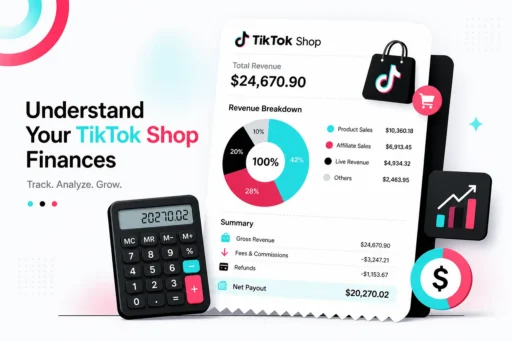
There's a line on your settled statement that says "adjustment," a negative number next to it, and no explanation a normal person can follow. Multiply that by a dozen line items a month and you have the most under-audited bucket in TikTok Shop accounting. Sellers verify their sales. Some verify their fees. Almost nobody verifies adjustments — which is exactly why errors live there.
Here's what adjustments are, which ones are legitimate, and how to tell the difference.
What an adjustment actually is
An adjustment is any money movement that happens outside the normal order math. Normal order math is: customer pays, refunds and fees come out, you get the rest. Adjustments are everything else — corrections, reversals, clawbacks, and credits applied after the fact. They show up in their own section of the settled statement, often weeks or months after the orders they relate to.
That timing gap is the problem. An adjustment posting in June for a March order is nearly impossible to sanity-check unless you reconcile deliberately. TikTok knows what it refers to. You usually don't.
The common types
Negative adjustments (money out):
- Chargebacks. A buyer disputed the charge with their bank and the loss was assigned to you. Whether it should have been is its own question — see our chargeback guide.
- Fee corrections in TikTok's favor. A fee undercharged earlier gets trued up later.
- Refund-related corrections. A refund processed after the original order already settled gets clawed back as an adjustment instead of a refund line.
- Promotion and program reconciliations. Co-funded discount math getting settled up after a campaign.
- Platform reversals. A catch-all for TikTok unwinding something it previously paid you.
Positive adjustments (money in):
- Reimbursement credits. Approved claims — FBT losses, logistics coverage — post here, typically within about 5 business days of approval.
- Fee corrections in your favor. Rarer, but they exist, mostly when a seller (or a service like ours) pushed for them.
The three tests for any negative adjustment
Run every negative adjustment through these:
1. Can you trace it to a specific order? Every legitimate adjustment refers to something real — an order, a chargeback case, a campaign. If you can't connect the line item to an underlying event, open a ticket and make TikTok explain it. "Unexplained" is not a category you accept on a financial statement.
2. Is the underlying event actually your liability? A chargeback on an order with clean delivery proof. A clawback for a refund that was caused by a carrier losing the package — which belongs under TikTok Shipping's logistics coverage (90 days from delivery, up to total retail value), not your ledger. The adjustment being real doesn't make it yours.
3. Is the math right? Correct amount, no duplicate, and — for clawbacks tied to refunds — consistent with what the original order actually settled at. Duplicated and double-counted corrections are exactly the kind of error that survives forever because nobody checks.
Fail any test, dispute it. Adjustments feel official because they're machine-generated, but machine-generated is not the same as correct.
Why this bucket compounds
Individually, adjustments are small — a few dollars to a few dozen. That's their camouflage. Across hundreds of orders a month they're a meaningful slice of the 1–3% of GMV we see leaking from unaudited shops (benchmarks here). And unlike a big scary $0 payout — which gets investigated the same day (that guide is here) — a slow drip of unverified adjustments never triggers anyone's alarm.
The discipline is simple: every statement, every adjustment, traced and tested. The execution is tedious, which is why we do it for sellers. Free audit of your TikTok Shop account within 24 hours — adjustments, refunds, fees, FBT losses, everything — every eligible claim filed within TikTok's terms of service, and we only get paid a percentage of what we recover. $710K+ recovered for sellers in 2026 so far.
Get your free TikTok Shop audit →
FAQ
What is an adjustment on a TikTok Shop statement? Any money movement outside normal order settlement: chargebacks, fee corrections, refund clawbacks, promotion reconciliations, platform reversals, and reimbursement credits.
Why did TikTok Shop deduct an adjustment from my payout? Usually a correction tied to an earlier order — a chargeback, a late refund, or a fee true-up. Every negative adjustment should be traceable to a specific order or case; if it isn't, open a ticket and dispute it.
Can I dispute a TikTok Shop adjustment? Yes. Dispute adjustments you can't trace to an underlying event, adjustments for losses that aren't your liability (like logistics-caused refunds), and any duplicate or miscalculated amounts.
Are adjustments ever in the seller's favor? Yes — approved reimbursements and fee corrections post as positive adjustments. Approved claims should appear on a settled statement within about 5 business days; verify they actually do.